ANWB My Account
Creating a shared direction for an account experience used across ANWB’s three main apps.
My ANWB is the account environment shared across ANWB’s three main apps. I led its redesign, turning a commercial ambition around cross- and upselling into a broader product direction that balanced business goals with what members actually needed from their account.
Because changes affected all three apps, moving the product forward required alignment across multiple Product Owners, designers and development teams.
My contribution
Product direction
I reframed a commercial cross- and upselling assignment around a broader question: how could My ANWB become more valuable to members while creating relevant opportunities for ANWB?
Evidence-based decision making
I used task analysis, customer research and validation to move discussions away from individual team preferences and ground product decisions in member needs.
Cross-team alignment
I took ownership of a product area that had been difficult to change because every decision affected three app teams. I brought Product Owners, designers and stakeholders together and created a shared direction despite different priorities and initial resistance.
Design & delivery
I translated the shared direction into an experience that could work across all three apps, taking it from early concepts through customer validation into detailed design and implementation with Engineering, QA and other designers.
The challenge
Moving a shared product forward when no team could change it alone
My ANWB is a shared component across ANWB’s three main apps. This created an unusual organisational challenge: a meaningful change in one place affected all three products.
Product Owners, designers and developers had different priorities and responsibilities, making larger changes difficult to align on. Over time, My ANWB had become a sensitive product area that teams were reluctant to take on.
My assignment started with a commercial ambition: increase cross- and upselling by making it easier for members to discover relevant products, services and upgrades.
I saw an opportunity to address the underlying challenge as well: create a shared direction for what My ANWB should become, giving the teams a common foundation from which the product could move forward.
Understanding what members needed from My ANWB
Instead of starting with how to introduce more commercial opportunities, I first looked at what members were actually trying to accomplish.
Through task analysis and customer input, I found that members primarily came to My ANWB to understand and manage their relationship with ANWB: checking membership information, understanding products and coverage, changing services, finding previous purchases and accessing saved content.
The existing experience made many of these tasks unnecessarily difficult. Information lacked hierarchy, important actions were difficult to find and the experience did little to adapt to the individual member.
This shifted the product question from “Where can we introduce cross- and upselling?” to “How can My ANWB become a useful personal environment where relevant next steps naturally have a place?”

Creating common ground across three product teams
A shared vision gave us something to align around
The challenge wasn’t simply finding a better interface. We needed a direction that Product, Design and Engineering across three apps could support.
I used the customer insights as common ground and organised a collaborative session with stakeholders and team members to define what My ANWB should ultimately provide.
We aligned around a shared vision:
To be a personal guide, standing by your side every step of the way.
The vision gave us a way to evaluate decisions beyond individual team preferences. My ANWB should help members understand what they have, what they can do and what might be relevant to them next.
This also gave the commercial ambition a more useful role: cross- and upselling should emerge through relevance to the member, rather than simply increasing the amount of products shown.
To be a personal guide, standing by your side every step of the way.
✴︎
To be a personal guide, standing by your side every step of the way. ✴︎
Making the direction tangible
A shared vision wasn’t enough to resolve the differences between teams. We needed to see how it would work as a product.
I translated the direction into concepts and interaction models and used them in weekly critiques with designers from the other app teams. This allowed us to discuss concrete choices around content, hierarchy and interaction rather than debating the direction in the abstract.
The work progressively turned a sensitive cross-team discussion into an experience that could realistically work within all three apps.

Building alignment around the experience
As the direction became more concrete, I developed it into a higher-fidelity experience that Product Owners and stakeholders could evaluate together.
The designs connected member needs with ANWB’s business ambition: giving members clearer access to the products and services they already had while creating relevant opportunities to discover, change or upgrade services.
This helped move the conversation from whether a shared direction was possible to how we could make it work.

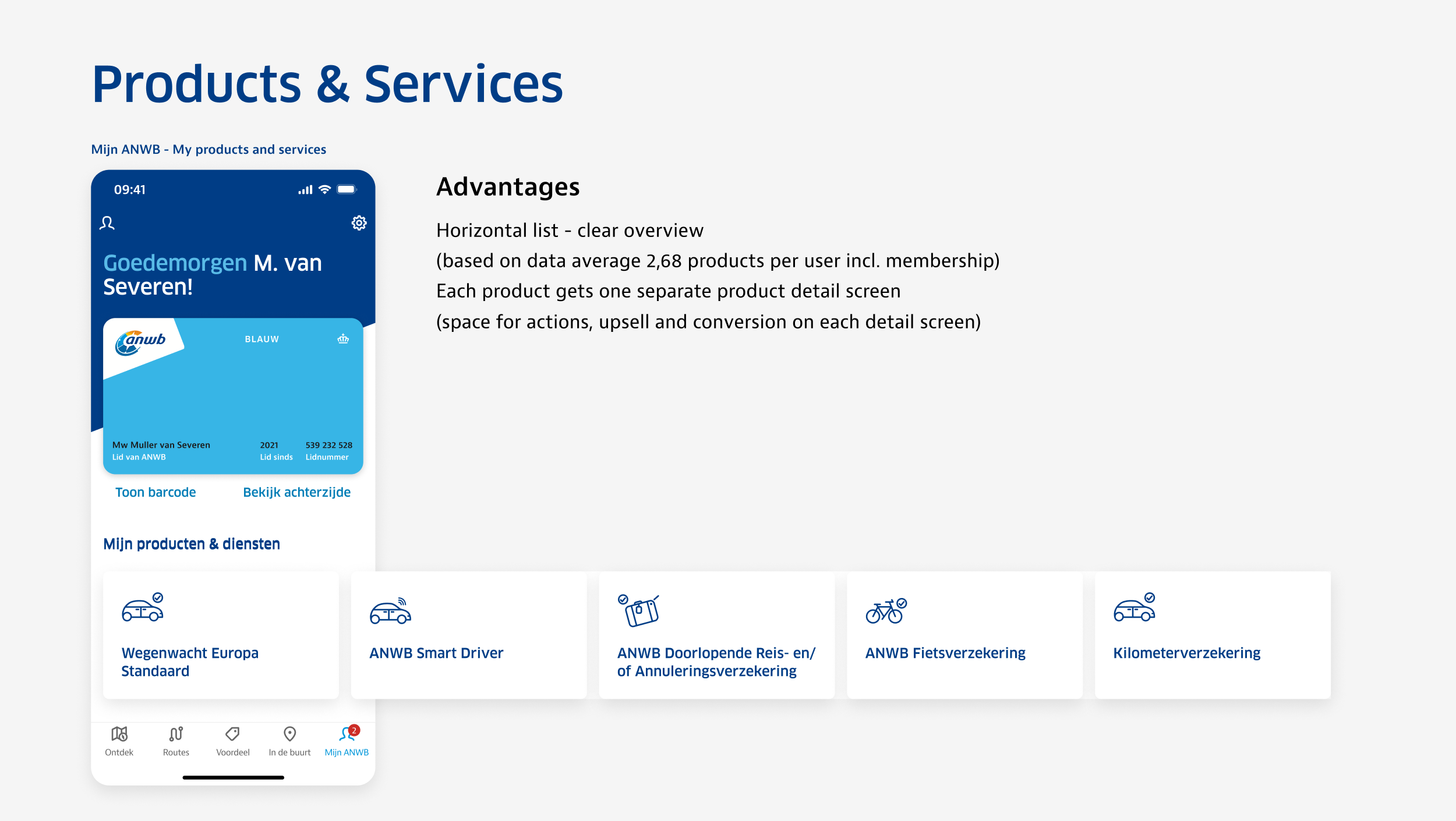


Slides I used to facilitate the discussion around the feasibility of a shared direction.
Taking the direction back to members
Once the teams were aligned around the proposed experience, we needed evidence that it also worked for the people using it.
Together with ANWB’s UX Research team, I set up customer validation at the ANWB store in The Hague. I defined the scenarios and research questions, created the interactive prototype, interviewed members and shared the findings across the organisation.
The research allowed us to identify remaining issues and refine the experience before development, while giving the teams customer evidence behind the decisions we had made together.


From direction to delivery
I worked with Engineering and QA to translate the validated direction into detailed requirements and support implementation across the apps.
Because the new experience introduced patterns that weren’t yet available, I also worked with designers from the other teams to add missing components to the shared Figma design system.
Where the experience crossed into other ANWB channels, we aligned with the web teams to improve consistency beyond the apps themselves.
Outcome
Turning a sensitive product area into a shared experience
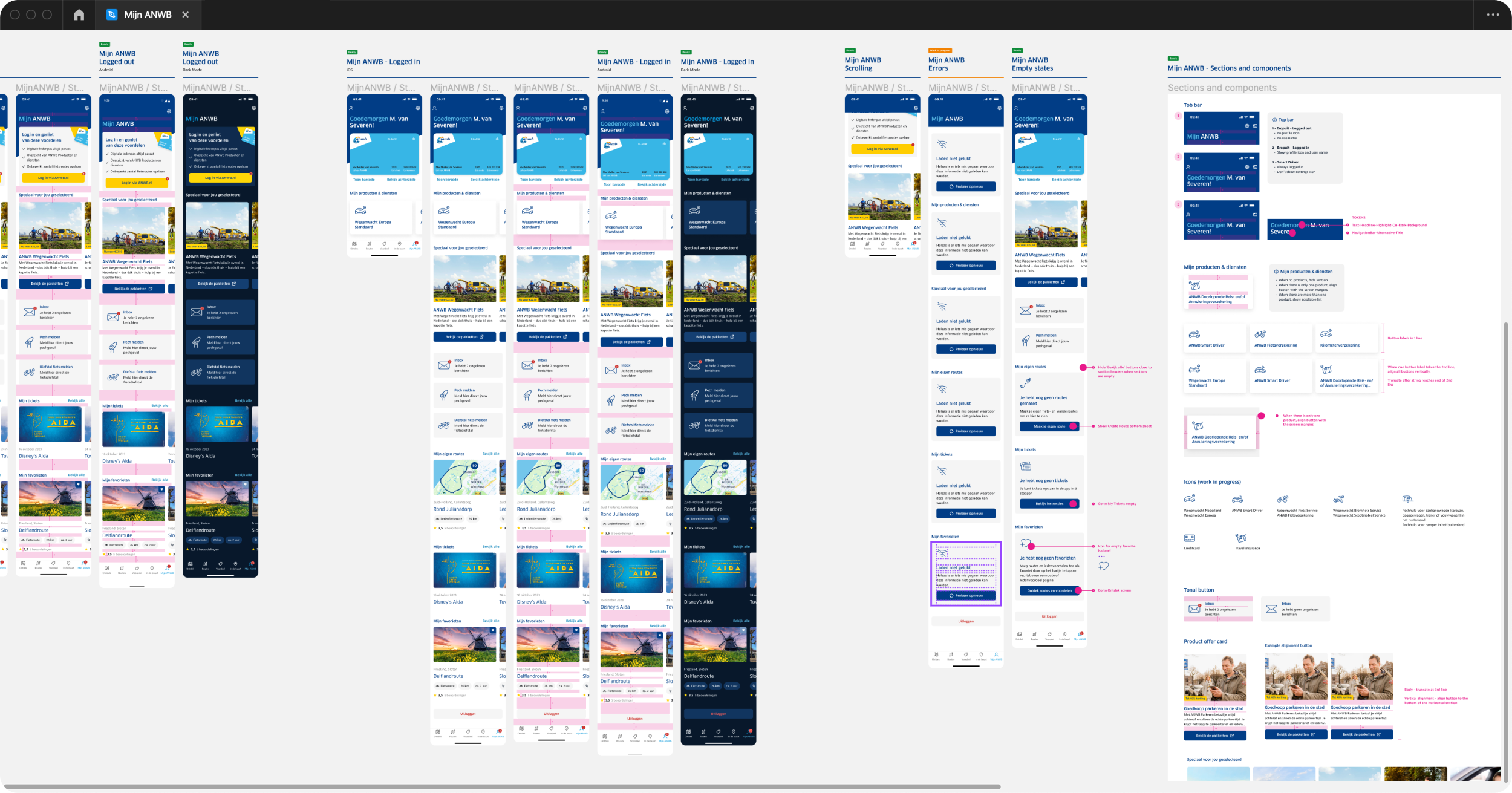
The project established a shared direction for My ANWB across ANWB’s three main apps — a product area the organisation had struggled to move forward because changes required agreement across multiple teams.
By grounding the direction in member needs, we were able to move beyond competing team perspectives, align Product, Design and Engineering around a common experience, validate it with members and take it into implementation.
The resulting My ANWB experience was implemented across the three apps and remains live today.
My contract ended before sufficient post-launch data was available for me to evaluate its effect on cross- and upselling, engagement or retention, so I don’t attribute quantitative business impact to the redesign.
Other case studies

ANWB Eropuit App
How I increased user satisfaction by optimising the performance of new and existing features in the ANWB Eropuit app.
Client: ANWB
Methods: User survey, competitor analysis, analytics based iterations.

LeasePlan Partner Portal
How I led the UX design for a B2B2C portal, enabling brokers, dealers and franchisees to onboard new customers, configure vehicles and sell lease contracts to SME customers in 30+ countries.
Client: LeasePlan Digital
Methods: User interviews, card sorting analysis, wireframes and mockups, page flows, prototyping, usability testing, design sprint.

FedEx
Recipient Experience
How I improved the recipient experience for 2,2 million engaged users in the US market and other 41 countries by leading the UX design for the iOS and Android apps.
Client: FedEx
Methods: Heuristic evaluation, stakeholder interviews, prototyping and usability testing, visual design.

ANWB Design System
How I ensured design consistency through all ANWB apps by translating the new ANWB brand guidelines to mobile and creating a unified Design System based on Figma tokens.
Client: ANWB
Methods: Design System, rebranding strategy.

TNT Design Language
How I led the TNT Design System team, shaping and evolving the TNT design language across all platforms, and helping create a consistent user experience across all touch points.
Client: TNT
Methods: Design System, responsive design, atomic design, workshops.